

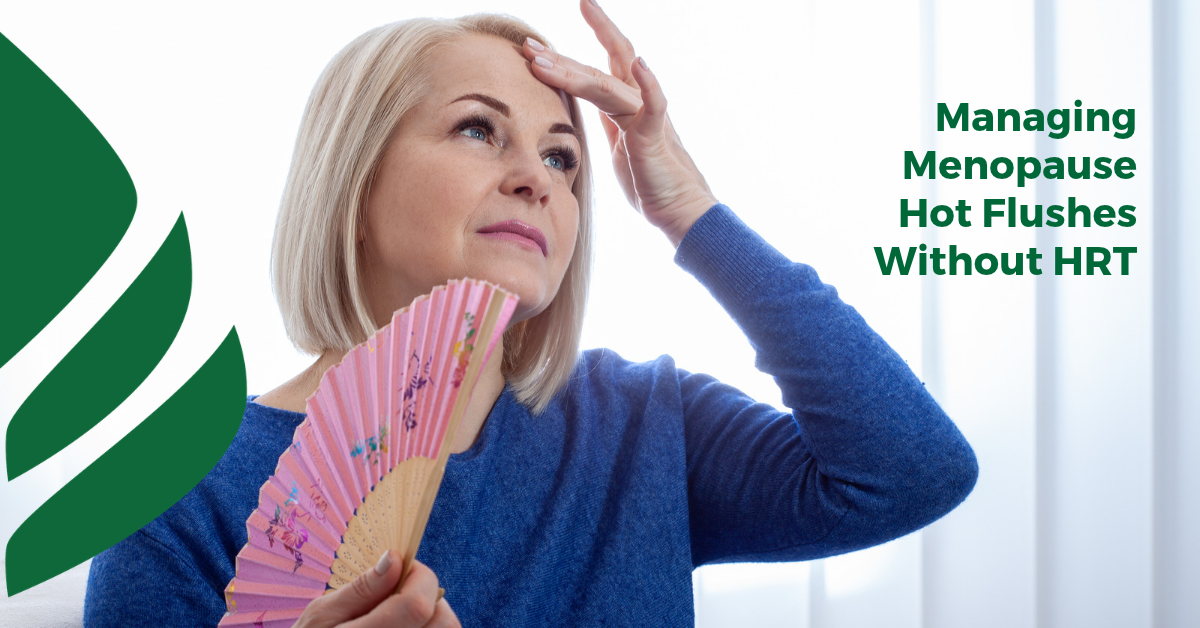
Hot flushes are the signature symptom of the menopause transition and among the most widely experienced. For some women they are a mild and transient warmth, an inconvenience rather than an impairment. For others they are waves of heat so intense they disrupt concentration, work, social situations and sleep. They can begin before periods become irregular, continue for years into post-menopause, and vary considerably in frequency and severity from woman to woman and from month to month within the same woman.
Understanding why they happen, what influences their severity and what genuinely helps to reduce them is the practical starting point for managing them well.
What Causes Hot Flushes in Menopause and Why Are They Worse at Night?
Hot flushes are primarily a thermoregulatory event. The hypothalamus, which governs the body's temperature regulation, becomes more sensitive to small fluctuations in core body temperature as oestrogen levels decline. In women with normal oestrogen levels, the body tolerates a relatively wide range of core temperature before triggering a cooling response. In perimenopause and menopause, this thermoneutral zone narrows considerably. Minor temperature increases that would previously go unnoticed instead trigger an immediate heat-dissipation response: peripheral blood vessels dilate rapidly, blood rushes to the surface of the skin, and the body sweats in an attempt to cool down. The result is the characteristic wave of heat, flushing, sweating and sometimes heart palpitations that defines a hot flush.
Noradrenaline and serotonin are both involved in the triggering pathway. When oestrogen declines, central noradrenaline levels rise; this increase is thought to lower the temperature threshold at which the hypothalamus activates the flush response. This is one reason that stress, which elevates noradrenaline, can worsen hot flush frequency and intensity.
At night, the same mechanism is compounded by the body's natural temperature rhythms during sleep. Core temperature drops gradually through the night as part of the normal sleep architecture. In women prone to vasomotor symptoms, this temperature movement, combined with the warmth of bedding and a body that is already primed to over-respond to thermal change, creates conditions in which night sweats occur with particular frequency. This is why vasomotor symptoms are so disruptive to sleep architecture even when the flush itself does not fully wake the woman.
How Long Do Hot Flushes Last and When Do They Typically Peak?
The duration of individual hot flushes varies but is typically between one and five minutes, sometimes accompanied by a chill as the cooling response overshoots. What is less well understood by many women is the overall length of time vasomotor symptoms can persist. Research from the Study of Women's Health Across the Nation found that vasomotor symptoms persist for a median of 7.4 years from onset, with women who begin experiencing them earlier in the perimenopausal transition typically reporting the longest overall duration. Some women continue to experience hot flushes well into post-menopause, in some cases for more than a decade.
Hot flush intensity tends to peak in late perimenopause and the first two years of post-menopause, as oestrogen levels complete their decline and the body begins to adapt to a new baseline. This means that the period immediately surrounding the final period is often the most challenging from a vasomotor perspective. Frequency can range from a few per week to dozens per day, and it fluctuates with stress, sleep quality, alcohol intake, ambient temperature and other modifiable factors.
For women who are still menstruating, hot flushes are often more frequent and intense in the week before a period, when progesterone is declining. This cyclical pattern can help distinguish hormonally driven symptom variation from other causes.
Non-HRT Options for Managing Hot Flushes: What the Evidence Supports
There is a meaningful body of evidence for non-pharmacological approaches to hot flush management, spanning lifestyle, mind-body practices and herbal medicine.
Cognitive behavioural therapy (CBT) adapted for menopause has demonstrated reliable effectiveness for reducing the distress and impact of hot flushes, even when it does not significantly reduce the number of flushes themselves. For women whose hot flushes are closely linked to stress or anxiety triggers, CBT addresses the sensitised nervous system response that amplifies the flush experience.
Mindfulness-based approaches have also shown benefit, reducing the perceived severity and bother of hot flushes rather than necessarily their physiological frequency. For many women, particularly those who find that flushes feel out of proportion to what they would expect, a mindfulness component can be a meaningful complement to other measures.
Practical environmental strategies, while less clinically glamorous, are often highly effective: keeping the bedroom cool (17 to 19 degrees Celsius), using moisture-wicking bedding, wearing breathable layered clothing, keeping a cold water spray at hand and avoiding known triggers reduce the frequency and severity of flushes in ways that are immediate and cumulative.
The Role of Phytoestrogens and Botanical Medicine in Reducing Menopausal Hot Flushes
Phytoestrogens are plant compounds that can interact with oestrogen receptors, providing a weaker oestrogenic signal in tissues where oestrogen activity has declined. The most clinically studied phytoestrogens for hot flush management are isoflavones, found in soy, legumes and red clover, and lignans, found in flaxseed and wholegrains.
Red clover (Trifolium pratense) contains a particularly high concentration of isoflavones and has been studied specifically for its role in reducing hot flush frequency and intensity. The evidence base supports its use as part of a broader botanical approach to vasomotor symptom management, with effects that are generally modest but clinically meaningful for women who prefer not to use hormonal therapy.
Black cohosh (Actaea racemosa) is among the most studied botanical medicines for menopausal hot flushes. Unlike phytoestrogens, its mechanism of action does not appear to be primarily oestrogenic; it is thought to act on serotonin and dopamine pathways that modulate the thermoregulatory response. This makes it relevant even for women with oestrogen-sensitive conditions who need to avoid phytoestrogens. Its clinical history in the German Commission E monograph system and subsequent RCT data support its use for vasomotor symptom relief.
Salvia officinalis (sage) has been studied clinically for its capacity to reduce hot flushes and night sweats, with traditional use in European herbal medicine that predates modern research by centuries. Shatavari (Asparagus racemosus) is a traditional Ayurvedic tonic herb for female hormonal support with a role in supporting oestrogen balance. Affron®, a clinically studied patented saffron extract (Crocus sativus), has been studied for its role in mood support, emotional resilience and reducing the distress dimension of vasomotor symptoms.
Foods, Drinks and Lifestyle Triggers That Make Hot Flushes Worse
Many women notice that their hot flushes are significantly worse after certain foods, drinks or in particular situations. Identifying and reducing personal triggers is one of the most practically effective steps available, and the impact can be immediate.
Alcohol is one of the most consistent triggers. Even modest alcohol consumption causes peripheral vasodilation and raises skin temperature, directly mimicking the physiological process of a flush. It also disrupts the second half of sleep, increasing night sweat frequency. For women experiencing significant vasomotor symptoms, reducing or eliminating alcohol is one of the highest-impact changes possible.
Caffeine raises core body temperature and stimulates the noradrenergic system, both of which lower the threshold for hot flushes. A stricter caffeine cut-off, or switching to cooler lower-caffeine alternatives, can meaningfully reduce daytime flush frequency. Spicy food and hot beverages trigger vasodilation directly and are reliably reported triggers across many women.
Stress is a significant and often underappreciated driver. The noradrenergic surge associated with acute stress lowers the temperature threshold at which the hypothalamus triggers a flush. Chronic stress keeps the nervous system in a more reactive state, which correlates with more frequent vasomotor symptoms. Stress management is not an add-on to hot flush management; it is central to it.
Higher body weight is associated with more severe vasomotor symptoms. Adipose tissue is an additional source of heat production, and the insulating effect of excess body fat reduces the body's ability to dissipate heat efficiently. For women whose weight has shifted during perimenopause, this contributes to both the frequency and subjective intensity of flushes. Smoking increases vasomotor symptom frequency, as does wearing synthetic, non-breathable clothing, which traps heat against the skin.
NaturoElite's Menopause Day Formula brings together the key botanicals with clinical evidence for daytime vasomotor support in a practitioner-formulated capsule: red clover, black cohosh, shatavari, Rehmannia, Hypericum perforatum (St John's Wort) for emotional wellbeing and mood balance, and Affron®, a clinically studied patented saffron extract (Crocus sativus), for mood support and emotional resilience.
For women who are still in the perimenopausal phase and experiencing hot flushes alongside cycle irregularity and hormonal imbalance, Female Balance addresses the progesterone-supporting and oestrogen-modulating dimension of early transition symptoms. Featuring Vitex agnus-castus, St John’s Wort, Safr'Inside® patented saffron extract (Crocus sativus), Bupleurum falcatum, pomegranate, rosemary and zinc in clean, organic pullulan capsules.


